


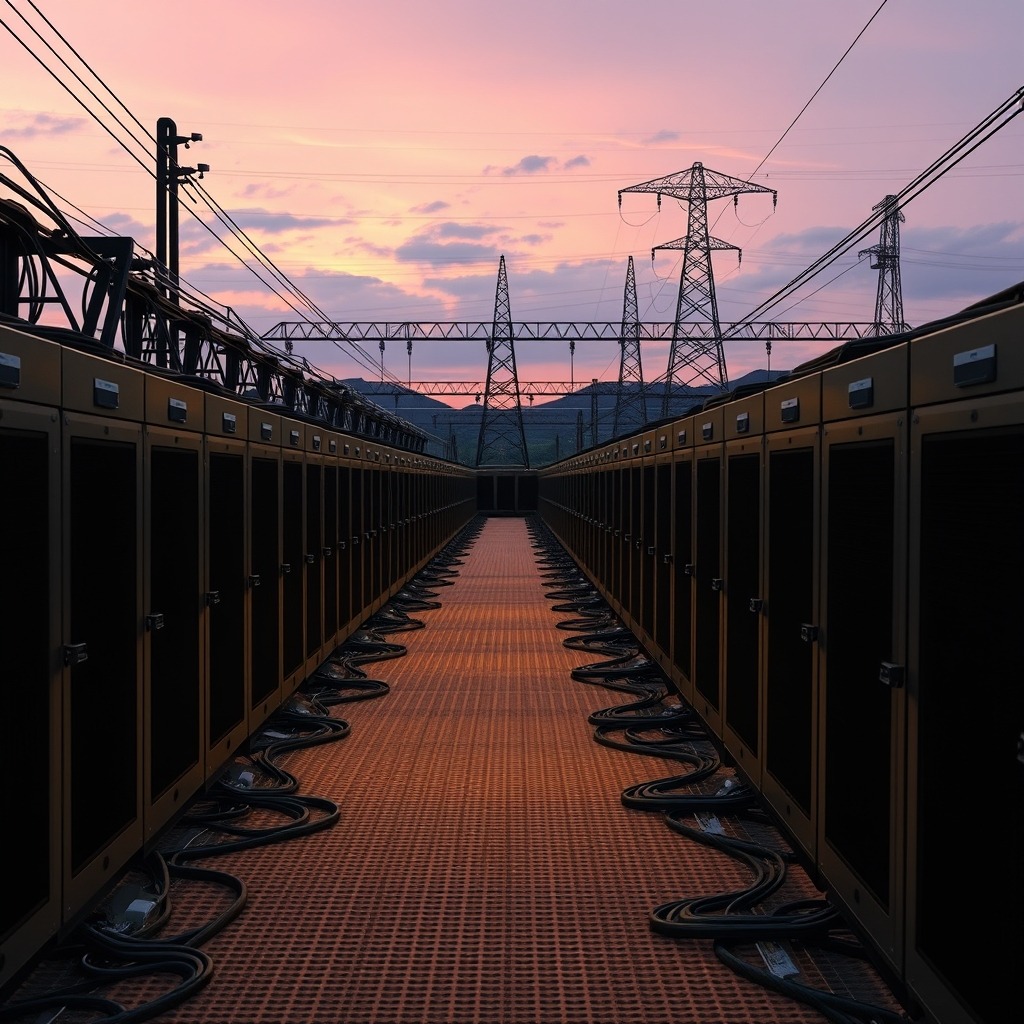
Roughly a fifth of the Bitcoin network’s mining power is sitting idle, and switching it back on could spring a brutal margin trap. Luxor estimates around 235 exahashes per second of capacity is offline for mixed reasons — a number large enough to complicate one of the market’s favorite signals, the so-called miner capitulation. For traders who watch hashrate as a proxy for network health and sell pressure, that muddies the read considerably.
What Happened
The estimate puts about 235 EH/s of mining capacity in the dark right now. Crucially, it is idle for mixed reasons — not purely because miners are unprofitable and capitulating, but also because of factors like grid curtailment, maintenance, and strategic downtime. Texas’s summer curtailment window, when miners power down to relieve grid strain during peak demand, is ending, which means some of that idle capacity is poised to come back regardless of price.


That is the trap. When curtailed machines switch back on, network hashrate rises and mining difficulty follows. Higher difficulty means each unit of hashpower earns fewer coins, squeezing margins for every miner — including the ones that never went offline.
What It Means for Traders
The first implication is that hashrate signals are noisier than they look. A drop in active hashrate is often read as miner capitulation — distressed operators shutting down and potentially selling reserves, historically a rough proxy for local price bottoms. But if a big chunk of the decline is curtailment rather than distress, the capitulation signal is contaminated, and traders leaning on it could misread the cycle.
The second implication is a coming margin squeeze. As idle capacity returns and difficulty climbs, weaker miners face thinner profitability, which can force real capitulation and coin sales later — even if price is stable. That is a structural headwind traders should factor into supply expectations, and it is closely tied to how miners are diversifying revenue, a shift visible when TeraWulf’s mining revenue fell 73% as AI leases took over.
The practical move is to treat hashrate and difficulty as a combined signal rather than reading hashrate alone. The interplay between curtailment schedules, difficulty adjustments, and miner balance sheets is where the real supply pressure builds.
The Bigger Picture
Bitcoin mining has become an energy-trading business as much as a crypto one. Miners increasingly optimize around power markets, curtailment payments, and alternative uses for their infrastructure — a convergence underway as AI data centers adopt the demand-response grid playbook that Bitcoin miners pioneered. That makes raw hashrate an increasingly blunt instrument for reading miner intent.
The competition for power and capital is also reshaping who mines and why. Some operators are pivoting hardware toward higher-value compute, as seen when Riot sold Bitcoin to fund a multibillion-dollar AI deal. Idle capacity that could return is not just a difficulty variable — it is a signal of how flexibly the industry now allocates its machines.
For traders, the lesson is to upgrade the mental model. Hashrate is no longer a clean thermometer for miner stress; it is one input in a system shaped by energy markets and difficulty mechanics. The 235 EH/s question — how much comes back, how fast, and at what price — will do more to shape near-term miner-driven supply than any single price level, and it deserves a place on every serious trader’s radar.
This article is informational only and does not constitute financial advice.