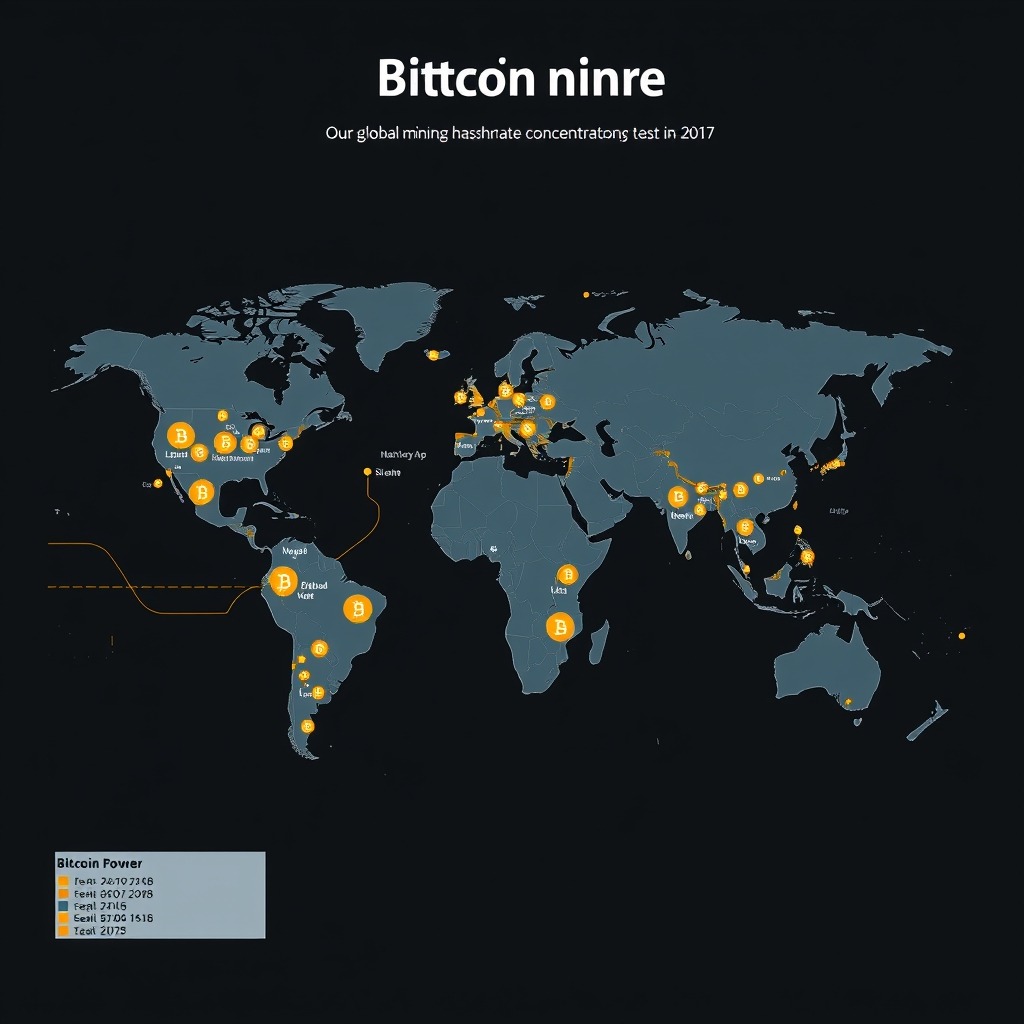
Bitcoin mining remains strikingly concentrated: an October comparison of estimated global hashrate still places roughly two-thirds of it inside just three countries. That 66% figure matters to traders because the geographic distribution of mining shapes network resilience, regulatory risk, and the odds of sudden hashrate shocks that ripple into price and difficulty.
What Happened
Fresh hashrate estimates show three countries accounting for about 66% of the Bitcoin network’s computing power, with one challenger steadily closing the gap. The data tracks where machines are plugged in, not who owns them or which pools coordinate the work, so the concentration is geographic rather than a direct measure of control.


That distinction is important. A country can host large mining operations run by companies domiciled elsewhere, and pool operators can route hashrate across borders. Still, the headline is clear: mining is far from evenly spread, and the ranking of host nations keeps shifting as energy prices, policy, and buildout timelines change.
What It Means for Traders
Concentration is a tail-risk variable. When a large share of hashrate sits in a few jurisdictions, a single policy change, grid emergency, or seasonal energy crunch can pull meaningful computing power offline quickly. Abrupt hashrate drops can slow block production until the next difficulty adjustment, and they can briefly spook a market that treats network health as a confidence signal.
Traders also watch miner economics because miners are structural sellers. When margins compress, stressed operators tend to sell more coins to cover costs, adding supply pressure. The fact that a notable share of hashrate already sits idle suggests parts of the industry are operating near the edge of profitability, which makes the location and resilience of active capacity even more relevant.
The signal to monitor is not the 66% number in isolation but its direction. A gradual diversification of mining lowers single-jurisdiction risk, while renewed clustering raises it.
The Bigger Picture
Mining geography is downstream of policy and power. Jurisdictions that welcome miners with cheap, abundant electricity attract capacity, while hostile regimes push it elsewhere. Russia’s decision to extend mining restrictions in key regions is one example of how quickly a host nation can turn into a net exporter of hashrate.
There is also a long-run security question. Bitcoin’s defenses lean on a wide, competitive mining base, and researchers continue to probe weak points, including uneven block fees as a subtle security risk. Geographic concentration is another variable in that security equation, because resilience depends on how easily the network can absorb the loss of any single region.
The encouraging part is competition. A rising challenger narrowing the gap means capital and machines are seeking new homes, and that migration is how the network gradually spreads its risk.
The Bottom Line
Two-thirds of Bitcoin mining sitting in three countries is a reminder that network decentralization is a work in progress. For traders, the metric worth tracking is whether hashrate keeps concentrating or starts spreading, because that trend shapes both tail risk and the structural selling pressure miners bring to the market.
This article is informational only and does not constitute financial advice.